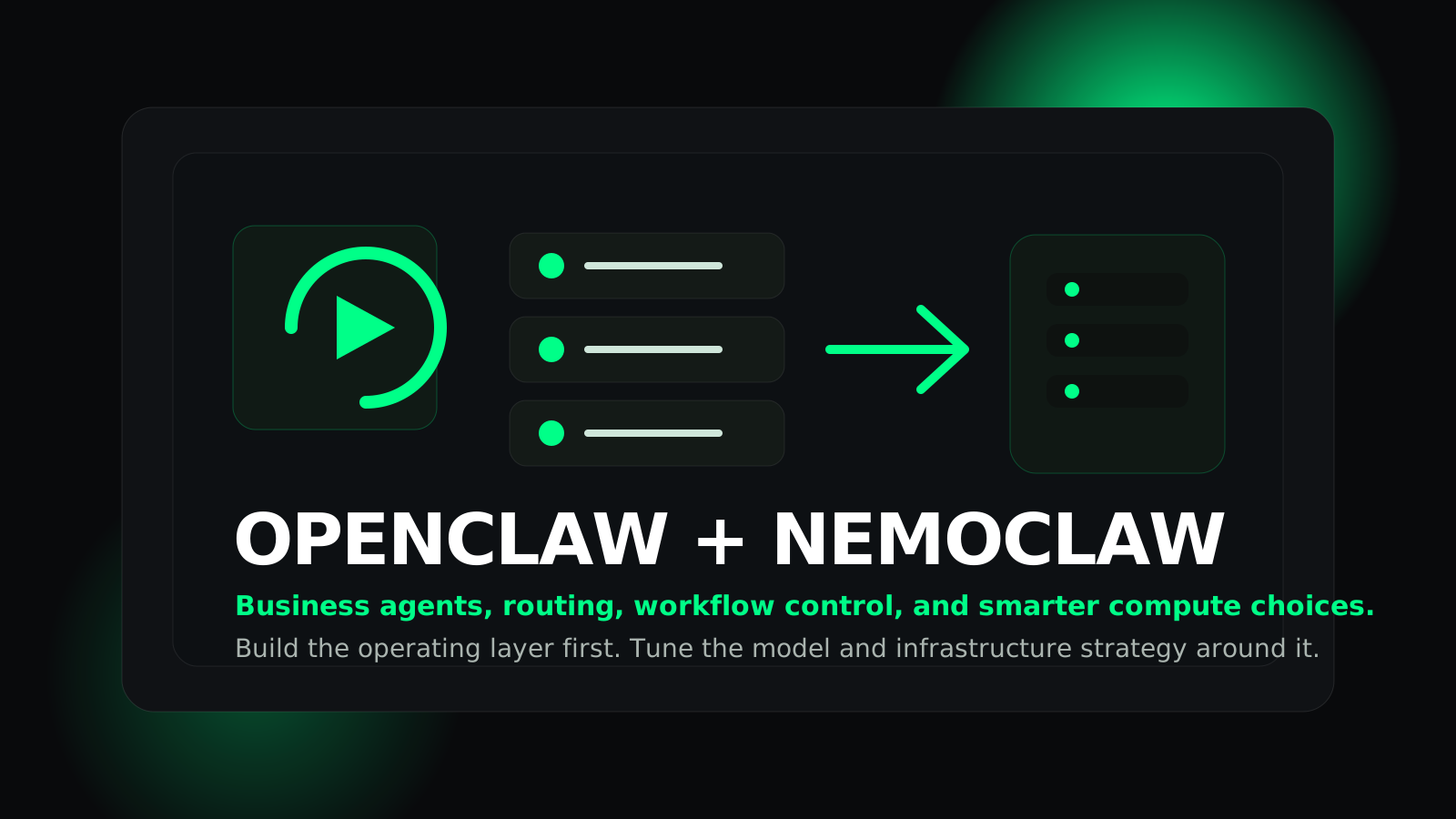
At a practical level, an OpenClaw-style platform is useful because it treats AI as an operational system, not just a chatbot. The value is not only in answering questions. The value is in wiring models, tools, channels, sessions, memory, approvals, and workflows into something a business can actually run.
That means the conversation moves away from “Which model is smartest?” and toward “What can this system do inside our business, how safely can it do it, and how much work can it remove from our team without creating new operational chaos?”
Business framing
If your AI stack cannot connect to messages, files, approvals, internal systems, and real operating rules, it is usually a demo layer, not an execution layer.
Where OpenClaw becomes useful
OpenClaw-style stacks are strongest when a business needs a multi-channel operational agent layer. That includes handling inbound messages, classifying intent, choosing the right tool path, logging context, handing off when needed, and keeping a usable audit trail of what happened.
Channel handling
One system can sit across WhatsApp, email, internal consoles, and web chat instead of every touchpoint becoming a separate custom bot project.
Agent routing
Different prompts, tools, and rules can be assigned to sales, support, intake, onboarding, or internal operations instead of one vague assistant trying to do everything.
Workflow execution
The system can trigger actions, update records, send responses, create tasks, or prepare drafts instead of only generating text.
Control and visibility
Businesses can inspect sessions, approvals, logs, and delivery paths instead of letting AI operate as an opaque black box.
This matters especially for service businesses, MSPs, agencies, operations teams, onboarding teams, and founder-led companies where communication volume is high but staff time is still finite.
What a NemoClaw-style deployment means in practice
Because “NemoClaw” is not a standard universal product label, the most useful business reading is this: a NemoClaw-style setup is an OpenClaw-style agent layer paired with a more specialized model and infrastructure strategy for privacy, performance, or cost control. In some cases that means a local or private model path. In other cases it means a hybrid design where heavier inference runs on dedicated infrastructure instead of through general public APIs for every task.
The point is not the name. The point is the design choice. Businesses often reach a stage where a single public-model call pattern is not enough. They want more control over:
Privacy
Sensitive internal workflows may need tighter control over where inference runs and what gets retained.
Latency
Repeated operational flows benefit from predictable response times and less routing overhead.
Cost shape
Heavy daily usage can justify dedicated infrastructure if the workload is stable enough.
Customization
Model choice, prompt design, retrieval, and tool permissions can be tuned around a specific business use case.
In other words, OpenClaw gives you the orchestration spine. A NemoClaw-style approach gives you a more intentional compute and model strategy around that spine.
How businesses benefit when this is done properly
The biggest wins usually come from operational compression. Staff stop spending hours doing low-value routing, repetitive summaries, draft replies, intake capture, duplicate copy-paste, and context reconstruction across channels.
Faster response handling
Sales and support teams stop losing time on first-level sorting and repetitive follow-up drafting.
Cleaner onboarding
Staff rollout, checklist capture, reminders, and status communication become more consistent.
Better internal leverage
Founders and senior operators are no longer the human API for every small operational decision.
Higher consistency
The system can enforce templates, rules, approvals, and escalation paths much more reliably than ad hoc human memory.
The real value is not only labour savings. It is operational clarity. A good agent stack reduces decision friction, shortens turnaround time, and keeps more institutional logic inside systems instead of inside scattered people.
Where Geek247 and CloudMonkey fit
This is exactly the kind of work Geek247 and CloudMonkey can help with, but the responsibilities are different and that distinction matters.
Geek247
Architecture, workflow design, agent logic, prompt structure, UI surfaces, business routing, inbox integration, internal tools, and the actual operational fit of the system.
CloudMonkey
Hosting strategy, managed environments, deployment discipline, uptime, patching, environment isolation, and the operating layer required to keep the system stable after go-live.
That split is useful for clients because it avoids a common mistake: building a technically interesting agent stack and then failing on the boring but critical parts like hosting posture, environment separation, patch cadence, backups, or change control.
Practical advantage
Geek247 can shape the system around the business. CloudMonkey can keep the runtime environment sane, secure, and supportable.
If you want to do it yourself, do these things first
A lot of businesses should prototype internally before committing to a larger rollout. That is healthy. But do it in a way that teaches you something useful.
Start with one high-friction workflow
Do not automate the whole company. Pick one painful, repeated, measurable flow such as intake triage, quote preparation, status updates, or support classification.
Measure the baseline first
Know how long the current flow takes, how often it breaks, what it costs, and where people get stuck. Otherwise “AI improvement” becomes emotional guesswork.
Separate orchestration from model choice
Do not hardwire the whole system around one model vendor too early. Your routing and workflow layer should survive model swaps.
Use retrieval before fine-tuning
Most businesses need better access to changing information long before they need custom model training.
Design approvals intentionally
Decide what the system can do automatically, what requires confirmation, and what must stay human-reviewed.
Keep the logs readable
You need to know what prompt path ran, what tool fired, what response was sent, and why the system behaved the way it did.
What to watch so you do not waste money and resources
This is where many AI builds go wrong. The waste usually does not come from one dramatic mistake. It comes from a pile of small bad decisions that compound.
Do not overbuy GPU too early
If your workload is still changing weekly, dedicated infrastructure can become expensive confusion. Prove the flow before you scale the hardware.
Do not send every task to the strongest model
Routing smaller jobs to lighter models or narrower paths is one of the fastest ways to control cost.
Do not build one agent that does everything
Single-agent sprawl creates prompt bloat, higher failure rates, and poor observability. Split responsibilities cleanly.
Do not skip memory and retrieval design
If the system cannot find the right business context efficiently, it will burn tokens and still answer badly.
Do not ignore hosting and runtime discipline
AI systems still break for normal reasons: weak deployment controls, stale packages, missing backups, bad secrets handling, and no rollback path.
Do not chase “fully autonomous” too fast
Semi-automated systems with clean approvals often produce better business value earlier than reckless end-to-end autonomy.
Efficiency checklist for a serious deployment
Use the cheapest model that still clears the quality threshold
Quality targets should drive routing, not vanity.
Keep prompts lean
Bloated prompts increase cost and latency while often making results worse.
Cache what is stable
Repeated system instructions, summaries, and low-change knowledge can often be reused instead of regenerated.
Keep tool use intentional
Every tool call introduces time, failure points, and compute overhead. Use tools because they add value, not because they look advanced.
Review logs for waste patterns
Look for loops, duplicate retrieval, repeated re-prompts, oversized context, and the wrong model tier being used for simple tasks.
Keep human fallback real
The system should fail gracefully into a person, not into silence or nonsense.
The practical conclusion
If your business wants real AI leverage, think less about “an assistant” and more about an operating layer. OpenClaw-style systems become valuable when they connect channels, memory, tools, sessions, and control. A NemoClaw-style path becomes valuable when you need a more deliberate model and infrastructure strategy around that operational spine.
If you want to build it yourself, start small, measure everything, and stay disciplined about routing, retrieval, approvals, and hosting posture. If you want it implemented properly without wasting months on architectural drift, Geek247 can shape the system and CloudMonkey can support the runtime environment that keeps it working.
Share This Article
Send it to your network, post it to social, or drop it straight into WhatsApp.