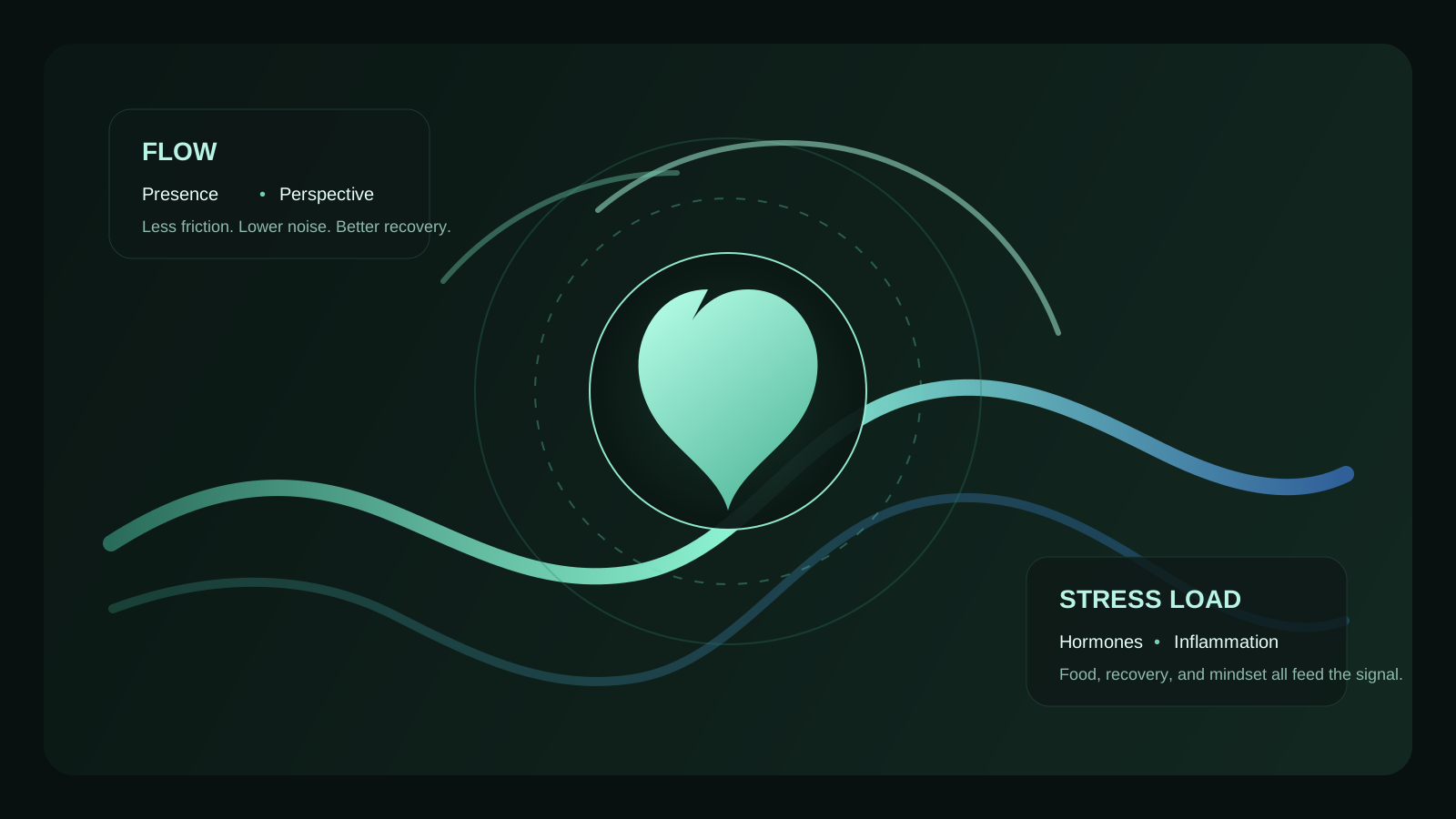
When you move with life rather than against it, friction begins to dissolve. That shift is not only philosophical. It is mental, emotional, and physical. Flow, perspective, and physical health all shape how much stress you carry and how quickly you recover from it.
A resilient life is rarely built by pushing harder against everything. It is built by learning where to focus deeply, where to release resistance, and how to keep the body from running on a constant alarm signal.
1. The power of flow: dissolving anxiety
Flow is often described as being in the zone. It is a state of total immersion where self-consciousness fades and time starts to feel different. In that state, attention becomes so complete that the mind has less room to generate noise.
Presence over pressure
Anxiety usually lives in the future through worry or in the past through regret. Flow anchors attention in the present moment, which leaves far less space for spiralling "what if" loops.
The challenge-skill balance
Flow tends to emerge when a task is demanding enough to be engaging, but not so overwhelming that it pushes you into panic or shutdown.
Neural quiet
Researchers often describe aspects of flow in terms of reduced self-monitoring. The inner critic softens, doubt loses volume, and the experience becomes cleaner.
Practical takeaway
If you want less anxiety, do not only ask how to calm down. Ask what conditions make it easier for you to become fully absorbed in the right kind of work.
2. Shift the lens: life is happening for you
The belief that life is happening to you creates helplessness. It makes every obstacle feel personal, unfair, and destabilising. Shifting to the frame that life is happening for you changes the emotional math.
Resistance vs. acceptance
Stress often comes from fighting reality after it has already arrived. When obstacles become information instead of insults, you stop wasting energy arguing with the fact that something happened.
Trusting the process
When difficult days are seen as part of development instead of proof that life is broken, the nervous system does not need to stay as tightly clenched around control.
Meaning changes load
The same event can hit very differently depending on whether it feels meaningless, threatening, or instructive.
3. The strategy of stepping back
In high-pressure environments, the instinct is usually to lean in harder. But stepping back is often the move that prevents reactive decisions and creates better thinking.
Create the gap Between a stressor and your reaction there is a space. Stepping back widens it, giving logic time to arrive before emotion drives the whole response.
Shift out of survival focus When you stop forcing a problem for a moment, the brain can move from narrow focus into broader pattern recognition.
Let breakthroughs surface Some solutions do not appear under pressure. They appear when the system relaxes enough to see something it was too clenched to notice.
4. The biological cost: stress and inflammation
Stress is not just a feeling. It is a systemic biological event. When the body remains in a long-term high-alert state, the cost spreads across multiple systems.
Hormonal
Ongoing cortisol and adrenaline release can keep blood sugar elevated, disrupt recovery, and make it harder to downshift into rest.
Immune
Chronic stress is often associated with higher inflammatory signalling, which can leave the body acting as if it is under constant threat.
Cardiovascular
Elevated heart rate and tighter blood vessels may be useful in short bursts, but not as a permanent operating mode.
Digestive
When the body prioritises defence, digestion can suffer. Appetite, absorption, and gut stability often reflect that shift quickly.
5. Processed foods: adding fuel to the fire
If stress is the spark, processed food can act like gasoline. What you eat shapes how stable your energy is, how well your gut communicates with your brain, and how much biological noise your system has to process.
Biological noise
Highly processed foods can aggravate inflammation in the gut. Because the gut and brain communicate constantly, that irritation often shows up as irritability, anxious energy, or a lower stress threshold.
The insulin rollercoaster
Refined carbs can drive sharp spikes and crashes in blood sugar. Those crashes can feel startlingly similar to anxiety symptoms: shakiness, racing thoughts, and agitation.
Nutrient depletion
Chronic stress increases the body's demand for supportive nutrients such as magnesium and B vitamins. Empty calories do little to replenish what constant pressure burns through.
Flow needs stability
It is much harder to enter deep presence when your energy, digestion, and mood are being jerked around by unstable inputs all day.
The takeaway
To move through life without carrying the full weight of the world on your shoulders, you need to manage both your mindset and your machinery. Find the conditions that make flow possible. Step back when reaction is too close. Shift perspective so difficulty becomes information instead of proof that life is against you. Then support the body with inputs that reduce inflammation rather than amplify it.
How has your energy been lately? Are you swimming against the current, or finding those pockets of flow where things start to move with less force?
Share This Article
Send it to someone who needs a reminder that resilience is both mental and physical.